



Rack Sizing: Technical Criteria for High-Precision Systems
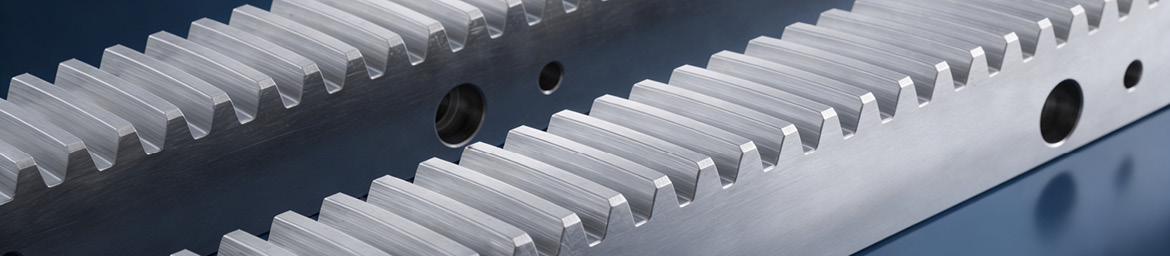
Rack sizing is a key step in designing high-precision linear drive systems. It goes beyond choosing the module; it also involves mechanical strength, structural rigidity, manufacturing quality, and proper integration with the pinion and support system.
In sectors such as robotics, machine tools, and industrial automation, proper sizing is essential to ensure positioning accuracy, motion repeatability, and long-term reliability.
Why sizing is crucial?
An improperly designed rack can cause:
– Tooth root fractures;
– Premature tooth wear;
– Vibration and noise;
– Loss of accuracy;
– Overload on the pinion, bearings, and actuators.
A proper design choice, however, allows for:
– Correct static and dynamic load capacity;
– Continuity of motion;
– Longer rack-and-pinion system life;
– Reduced maintenance costs.
Checking loads and coupling with the pinion
Sizing requires verification of:
– Tooth bending strength;
– Pitting resistance;
The rack and pinion must be designed as a single system, considering pitch diameter, number of teeth, and gear quality. Evaluating safety factors is the key element of the calculation.
Main project parameters
Modulus and pitch
The modulus directly affects the load-bearing capacity and stiffness of the tooth.
Other rack design parameters include the material and any heat treatment, the helix angle and the cross-section width, which contribute to the mechanical strength and stability of the assembly.
Length, cross-section, and stiffness
The rack must also be evaluated as a structural element. Its cross-section, length, and fastening system must limit deformation under load and ensure stability even under high acceleration. The stiffness of the support directly affects the system’s precision. Fixing pins contribute to stability.
Materials and Heat Treatments
The most used materials are:
– Quenched and tempered steels;
– Alloy steels for case hardening;
– Stainless steels for corrosive environments.
The most common treatments include:
– Case hardening, for high tooth fatigue resistance;
– Nitriding, to reduce deformation and improve surface wear;
– Induction hardening, for high-load applications.
– The choice depends on the required performance and project requirements.
Sizing a rack isn’t just about force and speed, but also the expected operating hours. Each mesh generates cyclic stresses at the base of the tooth and contact pressures on the flanks: the higher the number of cycles, the greater the risk of fatigue failure and pitting.
The required service life therefore directly impacts safety factors. For the same load, a system designed for continuous operation and long life requires more stringent criteria than one designed for occasional use.
Therefore, the calculation must consider the number of cycles, operating regime, and required reliability. In intensive applications, it may be necessary to increase the modulus, use materials with greater fatigue resistance, or consider more effective surface treatments.
Rack sizing is an engineering process involving geometry, materials, treatments, and functional integration. A rigorous approach allows for the creation of reliable, precise, and durable linear transmission systems, improving overall system efficiency.
Discover our precision racks here: gambinimeccanica.com/products/