



Precision helical gears: helix angle, axial loads and design criteria
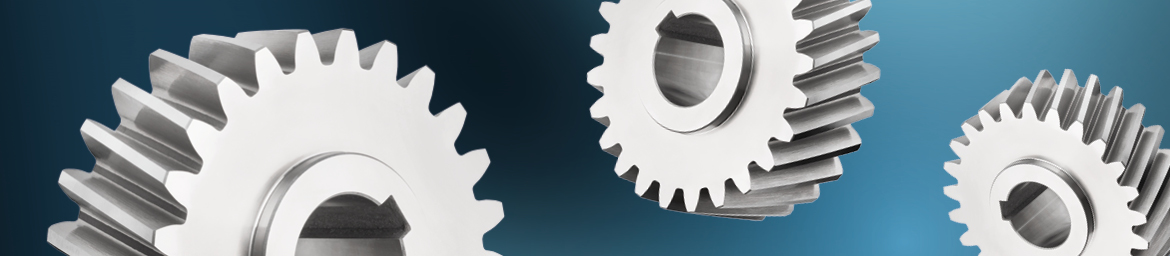
Helical gears are among the most widely used components in industrial mechanical transmissions when high load capacity, smooth operation, and reduced noise compared to spur gears are required.
The helical geometry allows for a progressive mesh between the teeth, with multiple teeth simultaneously in contact during motion transmission. This improves load distribution and reduces vibration and kinematic discontinuities.
However, the design and production of precision helical gears require proper management of some key technical variables, including:
– Helix angle
– Generated axial loads
– Bearing and support configuration
– Mechanical system rigidity
An incomplete design of these aspects can compromise the performance, reliability, and durability of the transmission.
Helix Angle in Helical Gears
The helix angle (β) is one of the main parameters in the sizing of helical gears.
This parameter directly influences:
– the number of teeth in mesh at one time
– the load distribution along the tooth flank
– the amount of axial force generated on the transmission
Increasing the helix angle generally results in:
– greater contact continuity
– reduced noise
– smoother transmission operation
At the same time, the axial component of the transmitted force increases, which must be correctly absorbed by shafts, supports and bearings.
For this reason, the choice of helix angle cannot be evaluated in isolation but must be included in the overall size of the shaft-bearing-structure system.
Axial loads in helical gears
One of the most critical aspects of helical gear transmissions is managing axial loads.
Unlike spur gears, helical gearing always generates a force component parallel to the shaft axis during torque transmission.
If this force is not adequately considered during the design phase, the following can occur:
– Bearing overload
– Increased operating temperatures
– Premature bearing wear
– Losing precision in motion transmission
It is therefore essential for the designer to precisely define:
– Direction of the axial load
– Amount of the generated force
– Duty cycle behavior of the transmission
This aspect becomes particularly critical in applications characterized by:
– Frequent rotation reversals
– Variable loads
– Intermittent duty cycles
Supports and Bearings for Helical Gears
The use of precision helical gears requires support systems capable of handling combined radial and axial loads.
The choice of bearings must therefore be consistent with the operating conditions of the transmission. Among the most used configurations are:
– Angular contact bearings
– Tapered roller bearings
– Back-to-back bearing configurations
The selection depends on several design factors:
– rotational speed
– precision required by the transmission
– operating thermal conditions
– expected system life
Incorrect bearing selection can compromise gear performance and reduce the reliability of the entire mechanical system.
Toothing Accuracy and System Rigidity
Compared to spur gears, helical gears are generally more susceptible to alignment problems.
The main problems can arise from:
– Angular misalignment between shafts
– Shaft deflection underload
– Assembly errors
For this reason, the toothing accuracy class must be evaluated together with the rigidity of the overall mechanical system.
A high-quality gear is insufficient to ensure proper performance if:
– The shaft is undersized
– The supports are inadequate sized
– The machine structure deforms underload
Transmission accuracy always depends on the balance between component quality and structural rigidity
Precision Helical Gear Production
In modern industrial applications, helical gears are often manufactured to specifications to meet load, precision, and service life requirements.
The production of precision helical gears generally involves:
– Gear cutting on specialized machines
– Dimensional inspection of the tooth profile
– Heat treatments to increase strength and durability
– Possible tooth grinding for high-precision applications
Furthermore, gears can be made with right- or left-handed teeth, with different helix angles, and with materials selected based on operating conditions.
The most common materials include:
– Case-hardened steels
– Hardened and tempered steels
– Special alloys
– Cast iron or bronze for specific applications
Specialized manufacturers such as Gambini Meccanica produce custom helical gears, designed for industrial applications requiring high reliability and precision in motion transmission.
Technical Data Required in the Request for Procurement
To avoid design ambiguities or rework, a request for quotation (RFQ) for helical gears should include some key technical information.
Key design data includes:
– Module and number of teeth
– Helix angle and direction of rotation
– Tooth precision class
– Material and heat treatment
– Rated loads and peak loads
– Operating regime and duty cycle
– Shaft coupling type
This information allows the manufacturer to correctly evaluate:
– Technical feasibility
– Most suitable manufacturing process
– Necessary dimensional and metrological checks
Helical gears are an effective solution for producing quiet, smooth, and highly load-carrying mechanical transmissions.
To fully exploit the benefits of helical gearing, it is necessary to comprehensively consider:
– Helix angle
– Axial loads
– Support configuration
– Mechanical system rigidity
Only consistent design and manufacturing of precision helical gears can ensure reliability, precision, and a long service life in the most demanding industrial applications.
Discover our helical gears here: https://gambinimeccanica.com/products/helical-gears/