



Materials and Heat Treatments for Racks and Gears: How to Choose the Most Suitable Solution
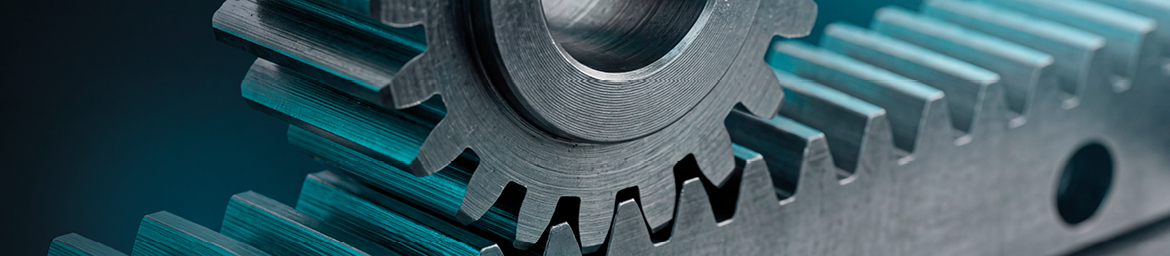
The choice of materials for racks and materials for gears has a direct impact on the performance of a mechanical transmission. Steel grade, heat treatments and finishing processes determine the component’s service life, positioning accuracy, wear resistance and long-term reliability.
In high-dynamic applications such as industrial automation, robotics, machine tools and material handling systems, defining the module, tooth geometry or accuracy class alone is not enough. To achieve optimal results, it is essential to select the most suitable material and combine it with the appropriate heat treatment cycle.
Why Material Selection Is Critical
During operation, racks and gears are subjected to high loads, cyclic stresses and continuous friction between the teeth. These conditions can lead to wear, elastic deformation and surface fatigue, gradually affecting the accuracy of the transmission.
The choice of steel therefore affects key factors such as:
– Load-carrying capacity;
– Resistance to pitting and wear;
– Structural rigidity;
– Dimensional stability;
– Service life.
For this reason, the material is always selected according to the actual operating conditions of the machine.
Steels for Racks: Which Ones to Choose
Steels used for precision racks are generally alloy steels designed to undergo subsequent heat treatments.
Case-Hardening Steels
Case-hardening steels are a reference solution for precision racks intended for applications involving high loads and demanding wear-resistance requirements. One commonly used material is 20MnCr5, a manganese-chromium case-hardening steel that is particularly suitable when a combination of high surface hardness and good core toughness is required.
Following case hardening and quenching, the component develops a very hard surface that is highly resistant to wear and contact fatigue, while the core retains a high level of toughness.
These characteristics make case-hardened racks particularly suitable for:
– CNC machine tools;
– Cartesian robots;
– Industrial automation systems;
– Material handling systems;
– Packaging machinery.
The combination of surface hardness and mechanical strength enables high performance even under intensive operating cycles and continuous acceleration and deceleration.
Quenched and Tempered Steels
When an application requires a good balance between mechanical strength and toughness, quenched and tempered steels can be used. A commonly used material is C45, a carbon steel that can undergo quenching and tempering to improve its mechanical properties according to the specific application.
Quenching and tempering increase strength and toughness, providing mechanical properties suitable for a wide range of industrial applications, particularly where the high surface-performance characteristics of a case-hardened component are not required.
Materials for Gears: How to Choose
The selection of materials for gears follows the same design principles used for racks. Each application has different requirements in terms of transmitted torque, speed, number of cycles, required accuracy, lubrication and operating environment.
In high-performance transmissions, case-hardening steels are often preferred because they provide high surface hardness and excellent resistance to pitting. For less demanding applications, quenched and tempered steels or other materials selected according to specific design requirements may be suitable.
The goal remains the same: to increase transmission efficiency, reduce wear and minimise maintenance requirements.
Heat Treatments: Adding Value to Racks and Gears
The final performance of a rack or gear does not depend solely on the material used. Heat treatments are an essential stage of the manufacturing process.
Case Hardening
Case hardening enriches the surface layer of the steel with carbon. After quenching, the component develops high surface hardness while maintaining a tough core capable of absorbing impacts and withstanding significant contact loads.
Quenching
Quenching increases the hardness of the material and significantly improves wear resistance, extending the component’s service life even under demanding operating conditions.
Quenching and Tempering
Quenching and tempering make it possible to achieve an optimal balance between mechanical strength, toughness and structural stability.
Precision Grinding
After heat treatment, grinding restores the correct tooth profile within extremely tight tolerances.
This process provides:
– Greater positioning accuracy;
– Reduced backlash;
– Lower noise levels;
– Improved meshing between pinion and rack.
Custom Racks: A Solution Designed for Every Application
An increasing number of manufacturers choose custom racks or tailor-made racks to meet requirements that standard components cannot fulfil.
A custom rack is designed starting from the actual operating conditions of the machine. In addition to tooth geometry, every characteristic of the component can be defined, from the material and heat treatment to precision machining and mounting systems.
This dedicated approach makes it possible to:
– Optimise transmission performance;
– Increase component service life;
– Reduce backlash and vibration;
– Simplify integration into the machine.
The result is a transmission perfectly adapted to the application, capable of providing greater reliability and efficiency.
From Design to Production
Manufacturing custom racks means following a complete engineering process that includes load and stress analysis, material selection, mechanical design, heat treatment, precision machining and dimensional inspection.
Only an integrated approach makes it possible to produce components capable of maintaining their accuracy and reliability even after millions of operating cycles.
Conclusions
The selection of steels for racks, materials for gears and the related heat treatments is one of the most important aspects of mechanical transmission design.
Material, heat treatment and machining accuracy must be considered as parts of a single system, as each decision directly affects the performance of the machine as a whole.
When applications require specific characteristics, custom racks and tailor-made racks make it possible to develop solutions perfectly adapted to individual design requirements, improving accuracy, service life and operational efficiency.
Investing in the correct selection of materials and manufacturing processes means designing transmissions that are more reliable, high-performing and capable of maintaining their performance over time.
Find out here our products.